
Fractional COO vs CFO: Which One Does Your Business Need First?
A fractional COO builds how your business runs. A fractional CFO tells you what the money is doing while it runs.
Both are worth having eventually. The one you need first is the one standing on your oxygen line right now, and there's a simple way to tell which.

In this post
01
Fractional COO vs CFO: the short answer
Fractional COO vs CFO comes down to one distinction. A fractional COO builds how your business runs. A fractional CFO tells you what your money is doing while it runs.
Both are senior leaders you bring in part time, and both will make your business better. They just fix different kinds of pain.
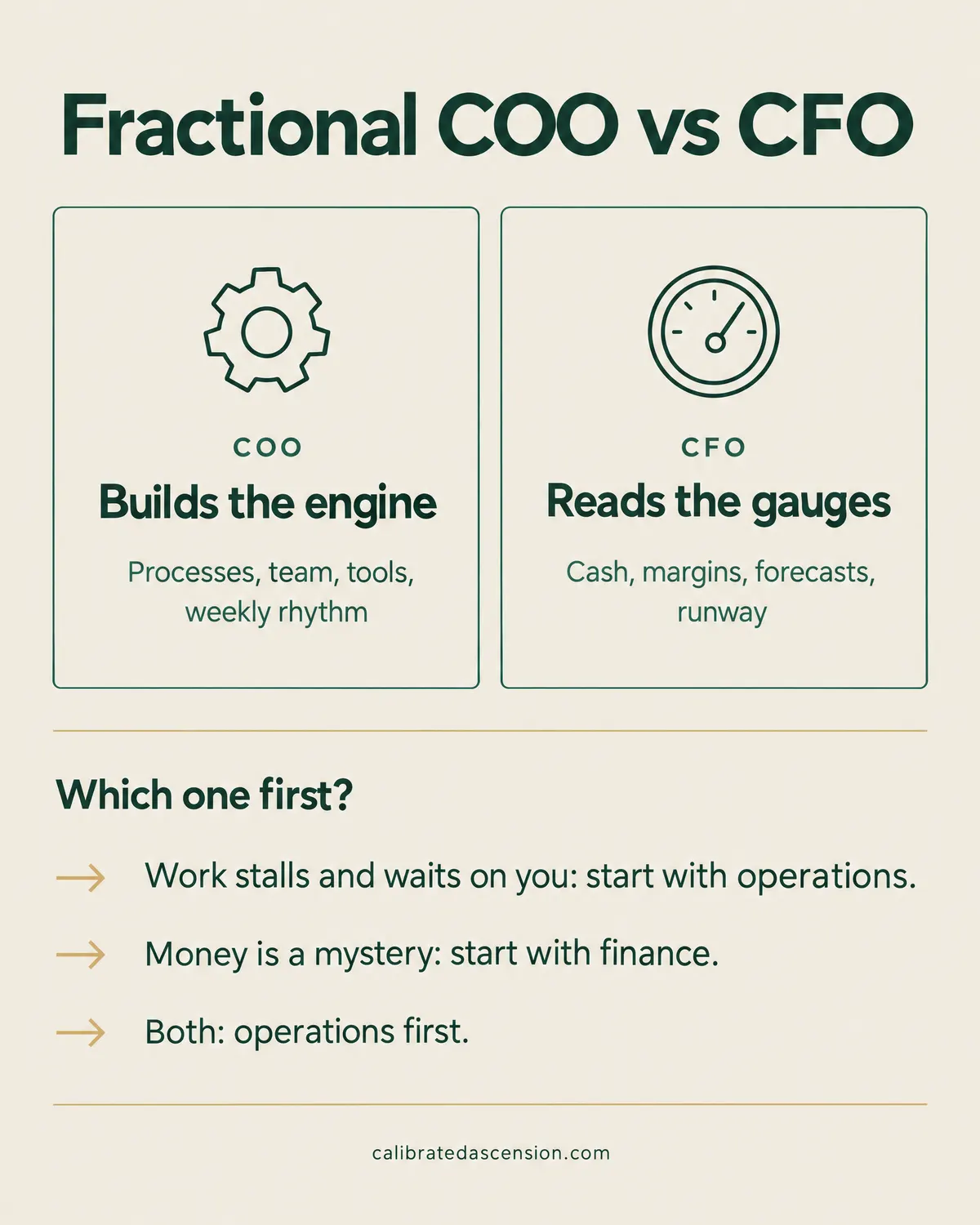
Think of it like driving. The COO is the one who tunes the engine, rebuilds the transmission, and teaches someone else to drive so you can get out of the seat. The CFO is the one reading the dashboard: fuel, speed, temperature, how far you can go before you need to stop.
A car with a perfect engine and no gauges runs out of gas on the highway. A car with perfect gauges and a broken engine never leaves the driveway.
So the real question isn't which role is better. It's which failure you're closer to right now.
02
What a fractional COO owns
The COO seat is about motion: how a lead becomes a client, how a client gets delivered to, who owns which decision, and how a plan turns into finished work every week. In a service business, that usually covers:
- Process design: mapping delivery end to end and removing the steps that only exist out of habit.
- Team structure: clear owners for clear outcomes, so decisions stop routing back to you.
- Tools and automation: consolidating a tech stack that doesn't talk to itself.
- Operating rhythm: the weekly and quarterly cadence that keeps everyone pointed in one direction.
The full breakdown of the role, including cost and how to interview for it, is in what a fractional COO actually does.
03
What a fractional CFO owns
The CFO seat is about truth in numbers. Not bookkeeping, which records what already happened, but financial management: reading those records and turning them into decisions about what happens next.
- Cash flow and runway: how much is coming in, when, and how long you can operate if it stops.
- Margins by offer: which of your offers actually makes money once delivery time and tools are counted.
- Forecasting: what next quarter looks like if nothing changes, and what it looks like if you hire.
- Pricing and tax planning: the numbers behind your prices, and no more surprise bills in April.
A good CFO makes money visible. You stop guessing whether you can afford the next move and start knowing.
Fractional COO vs fractional CFO, side by side
Here's the whole comparison in one place:
| Fractional COO | Fractional CFO | |
|---|---|---|
| Owns | How the business runs: processes, team, tools, rhythm | What the money is doing: cash, margins, forecasts, reporting |
| Core question | Can this business deliver without the founder holding it up? | Can this business afford its next move, and when? |
| Leaves behind | Documented systems, clear owners, automations, a weekly cadence | A cash forecast, margin view by offer, a reporting rhythm |
| Watches | Delivery quality, capacity, cycle times, decisions waiting on the founder | Cash flow, runway, margin, revenue against plan |
| Feels urgent when | Work stalls and everything routes through you | Revenue is up and the bank account doesn't agree |
Both roles are measured the same way in the end: by what you can do without them once they've done their job.
04
Which one does your business need first?
Hire for the constraint you can feel in your body, not the one that sounds more impressive. Read both lists below and notice which one tightens your chest.
You probably need operations first if:
- Work waits on you. Approvals, answers, and handoffs stack up in your inbox until you get to them.
- Delivery quality depends on your mood that week. Clients get a great experience when you're rested and a rushed one when you're not.
- You hired help and still do the work twice. There's no documented way things are done, so every task routes back through you.
- Launches run on adrenaline. Every one feels like the first one, with the same scramble in the final week.
You probably need finance first if:
- You can't say your margin on each offer. You know what you charge. You don't know what you keep.
- Tax season is a surprise every year. The number arrives and you rearrange your life around it.
- Hiring decisions are made by feel. You add a person when you're exhausted, not when the numbers say you can carry them.
- Revenue is up and the bank account doesn't agree. Money comes in and leaves faster than you can explain.
If the operations list hit harder, the seven signs you need a fractional COO will tell you how far along you are.
If both lists land equally, start with operations. It's hard to forecast a business whose delivery changes shape every month, and a CFO's numbers get far more useful once the machine producing them is steady.
05
Why the order matters

Picture a coach earning well who brings in a CFO, gets a beautiful margin report, and learns her group program is barely profitable. True, and useful.
But the reason it's barely profitable is that she personally answers every student message at 11 p.m. The fix isn't a spreadsheet.
It's a support structure, an FAQ library, and a teammate who owns the inbox. That's operations work.
The reverse happens too. A founder with tight systems and a calm team keeps hiring because work feels heavy, and nobody notices that payroll has quietly crossed what the business can carry. There the fastest relief is a finance lead who can show the runway in one number.
Both stories end the same way: the right hire in the right order feels like exhaling. The wrong order feels like paying someone to describe a problem you still have to solve yourself.
Can one person do both?
Sometimes, at small scale. Plenty of operators keep a basic financial dashboard, and plenty of finance leads will tidy a process or two. That overlap is fine when the business is small and the need is light.
Where it breaks is depth. Building a delivery system and building a cash forecast use different muscles, and almost nobody is equally strong in both.
So ask directly: "Which half of this would you hand off first?" A confident operator will name it without flinching. Someone who claims equal mastery of everything is telling you something too.
Before you hire either one
There's a step before both roles, and skipping it is expensive. If your offers are still scattered, a COO will make the scatter run faster and a CFO will produce a very accurate report of the scatter. Neither will tell you which offer to lead with.
That's a coherence question, not an operations or finance question. If you're not sure which kind of help you need, the leverage assessment is a free way to find where the constraint actually sits.
And when you do hire, use the same standard for both roles: judge them by what keeps working after they leave. A COO should leave systems your team runs without them. A CFO should leave numbers you can read yourself.
If either one leaves you more dependent than when they arrived, you bought their presence, not your capacity. The right first hire is the one that gives you your balance back, so the next push doesn't knock you over.
Common questions
What is the difference between a fractional COO and a fractional CFO?
A fractional COO owns how the business runs: processes, team structure, tools, and the weekly rhythm that turns plans into finished work. A fractional CFO owns what the money is doing: cash flow, forecasting, pricing math, margins, and financial reporting. One builds the engine, the other reads the gauges.
Should I hire a fractional COO or CFO first?
Hire for the constraint you can feel. If work stalls, decisions wait on you, and delivery depends on your personal attention, start with operations. If revenue is coming in but you can't say where it goes, whether you're profitable, or how much runway you have, start with finance.
Can one person be both a fractional COO and CFO?
Some operators cover light finance and some finance leads cover light operations, especially in small businesses. But the skill sets are genuinely different. Ask any candidate which half they would hand off first, and trust the answer.
Do I need a CFO if I already have a bookkeeper?
A bookkeeper records what happened. A CFO interprets it and helps you decide what happens next: pricing, hiring timing, cash reserves, and forecasts. If your books are clean but you still make money decisions by feel, that gap is what a fractional CFO fills.
How much does a fractional COO cost compared to a CFO?
Fractional COO retainers in the market typically run $3,000 to $10,000 a month, against $150,000 to $350,000 or more a year for a full-time COO. Fractional CFO pricing varies just as widely with scope, so compare what each would leave behind, not only the monthly number.
End of post
Continue exploring
Not sure which gap is costing you more?
The marketing audit is a paid diagnostic across offers, automation, and traffic. You leave with the analysis and a prioritized checklist, whichever hire it points to.
Book the marketing audit