
How a Fractional COO Contract Is Actually Structured
A fractional COO contract is usually a services agreement with a monthly retainer, a minimum term, a written scope, a notice period, and a handoff plan. The clause that matters most is the one people skip: who owns what was built, and how it gets handed back. Here's the full checklist, and the exact terms we use.

In this post
01
How fractional COO contracts are usually structured
Most fractional COO contracts are services agreements with a monthly retainer, a minimum term, a written scope, and a notice period. A few are hourly, for short advisory work. Some are fixed-fee projects, like an operations audit or a delivery rebuild with a clear finish line.
The format matters less than what it protects. A good fractional COO contract protects two things: your ability to walk away cleanly, and your ownership of everything that was built while you were paying for it. Everything else is detail.
A note before you read further: this is how operators structure these engagements in practice, and how we structure ours. It isn't legal advice. Have your own attorney review any agreement before you sign.
02
The clauses every fractional COO contract should include
Read any proposal against this table. The middle column is what good looks like. The right column is what should make you pause.
| Clause | What good looks like | Watch for |
|---|---|---|
| Scope of work | The outcomes, named. "Rebuild client onboarding and hand it to the team" beats "operations support." | Anything described only in hours or vague verbs like "support" and "advise." |
| Term and renewal | A minimum term long enough to study, build, and hand off, and a clear point where both sides decide whether to continue. | Open-ended month-to-month from day one, or a long lock-in before anyone knows the fit. |
| Fees and billing | A retainer tied to scope, billed on a predictable schedule, with what's included and excluded in writing. | Hourly billing for leadership work, or fees that rise without a scope change. |
| Notice and exit | A reasonable notice period and a defined handoff, so ending the contract doesn't strand your team. | No exit terms at all, or exit terms that leave your documentation behind. |
| Ownership | Every SOP, dashboard, automation, and document built for you belongs to you. | Systems built in the operator's own accounts that leave when they do. |
| Decision rights | What they can decide alone, what needs you, and how fast you'll respond. | An operator with responsibility for outcomes and no authority to act. |
| Access and confidentiality | Named tool access, client data handling, and confidentiality that covers your methodology and course content. | Shared passwords in chat and no written confidentiality. |
If you run a coaching or consulting business (more on how operations differ there in fractional COO for coaches), add one more line to the confidentiality clause: your methodology. An operator will see your curriculum, your client transformations, and your frameworks up close. That's intimate access, and the agreement should treat it that way.
03
How long is a typical fractional COO engagement?
Long enough to do three things: study the business, build what's missing, and hand it off. That almost never fits inside one month.
Operations work has a physical rhythm to it, like training for a race. The first weeks are assessment, the middle is load, and the end is making sure the body can hold the new pace on its own.
Shorter than that and you pay for a diagnosis without the treatment. Much longer, with no checkpoint, and the engagement can drift into a dependency nobody chose on purpose. That's why the best structures build in a natural decision point.
04
How we structure ours, and why
Our minimum engagement is one quarter: 90 days. A quarter gives us enough time to move in phases and actually study the operations before we start changing them.
- First, study. We inventory how the business actually runs, not how the SOPs say it runs: the founder's calendar, the client path, the tools, the numbers, and where decisions pile up.
- Then, build. We fix the highest-leverage breaks first and install the systems, owners, and weekly rhythm that keep them fixed.
- Then, hand off. We train the team on what was built, document it, and make sure it runs without us in the room.
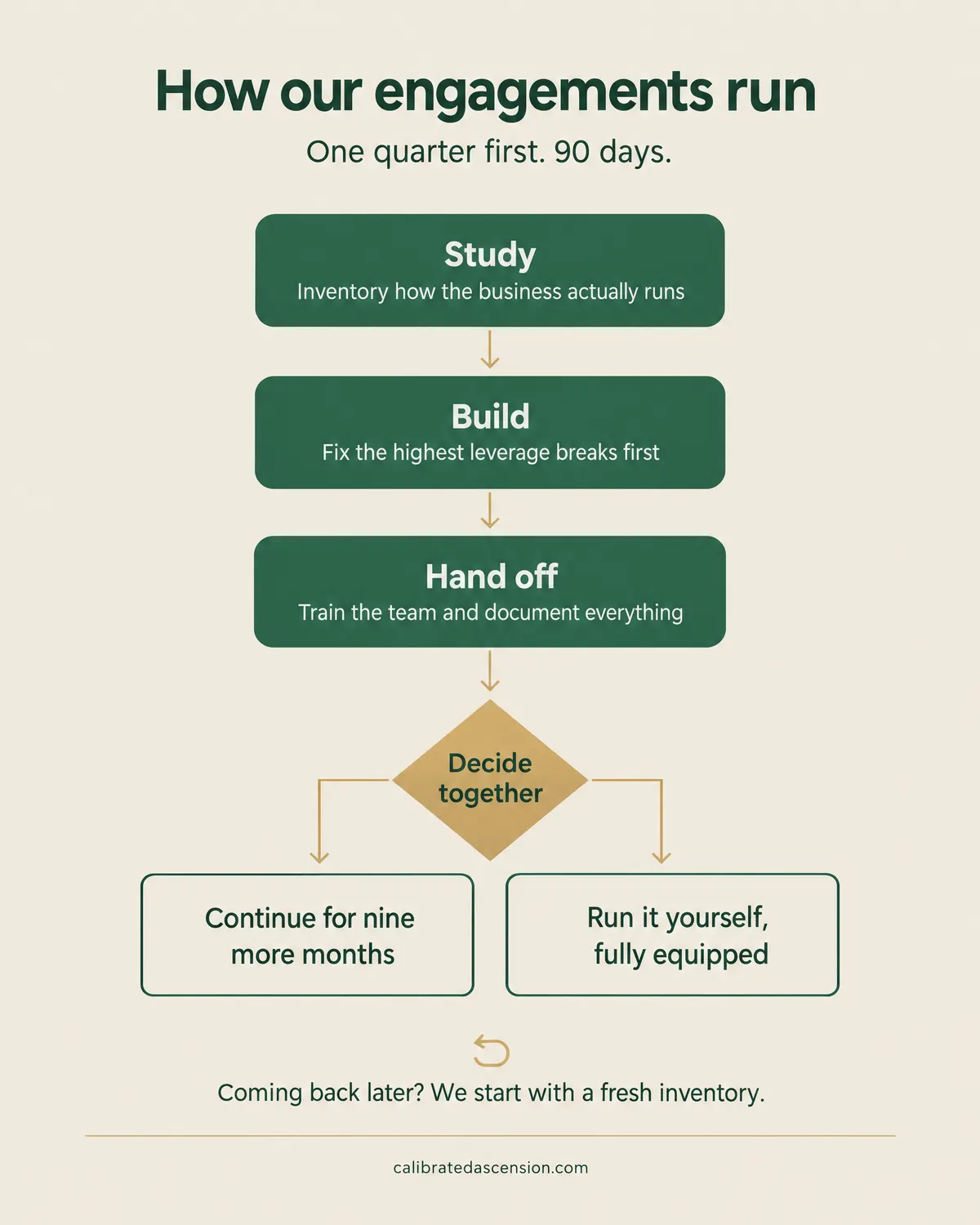
At the end of the quarter, we decide together. If it's a good fit, the team is moving in the same direction we are, and we're confident we can keep delivering on your goals, the engagement continues for the next nine months of the year.
From there it can keep going. Some of our clients have been with us for three years.
Plenty of founders do exactly that. They take a quarter or two to run it themselves, and some come back. When they do, the first thing we do is inventory again.
We look at what stopped happening while we were gone, and it's usually the same few things: copy that drifted off-message, traffic that nobody is tracking anymore, or a price that has changed several times without a strategy behind it. None of that is a failure. It's what happens to any system nobody is tending, and catching it early is most of the value.
05
How fractional COO fees work
Market retainers for fractional COOs typically run $3,000 to $10,000 a month, depending on scope and how deep the work goes. A full-time COO costs $150,000 to $350,000 or more a year in salary, before equity and benefits.
We don't bill hourly, and we'd gently push back on anyone who does for this kind of work. A fractional COO isn't your employee, and the job isn't a count of hours. We price a retainer from the projects in scope and what it realistically takes to deliver them.
That's because the work is more than advice. We consult, and we also solve: we take initiative, we build, and we train your team members to run what we built.
There's also a team behind the title. Our operators are backed by an agency, so work gets delegated to specialists inside our team rather than landing on one person's calendar.
When you compare quotes, compare what's behind the name. One consultant with opinions and an operator with a build team are two different products, even if the monthly number looks similar.
The clause that matters most is the exit

Before you sign anything, find the handoff language and read it twice. What gets documented?
Who gets trained? Where do the systems live, and whose name is on the accounts?
A fractional COO who plans the exit on day one is telling you they intend to make themselves unnecessary. That is the job. You're hiring someone to build a structure you can stand on, and the contract should prove that the structure stays standing when they step away.
The engagement can last three months or three years. Either way, the right agreement leaves your business steadier on its own feet at every checkpoint.
If you're still deciding whether operations is the right hire at all, start with what a fractional COO actually does, or read the signs you're ready for one.
Common questions
What should be included in a fractional COO contract?
At minimum: a written scope with named outcomes, the term and renewal terms, the fee and how it is billed, the notice period, decision rights, confidentiality, who owns the systems and documents created, access to your tools, and a handoff plan. If the handoff isn't in writing on day one, it rarely happens cleanly at the end.
How long is a typical fractional COO engagement?
Many engagements start with a minimum term of a few months, because operations work needs time to study, build, and hand off. Ours starts with one full quarter, 90 days, then continues for nine more months if the fit is right on both sides. Some of our clients have stayed three years.
Can I hire a COO part time?
Yes. That's exactly what a fractional COO is: senior operations leadership for part of the week or month, under a retainer or a defined project. You get the executive thinking without funding a full-time executive salary, equity, and benefits.
Is a fractional COO an employee or a contractor?
Almost always an independent contractor or a firm, working under a services agreement. How your jurisdiction classifies the relationship depends on the facts, so have your own attorney or accountant review the agreement before you sign it.
Who owns the systems a fractional COO builds?
You should. Your contract should say plainly that the SOPs, dashboards, automations, and documentation built for your business belong to your business. A good operator wants this too, since systems you own are the whole point of hiring them.
How are fractional COOs paid?
Usually on a monthly retainer, sometimes hourly for short advisory work, and sometimes as a fixed project fee. Retainers tied to scope tend to serve operations work best, since you're paying for outcomes and leadership rather than a count of hours.
End of post
Continue exploring
Want to know what your first quarter would focus on?
The marketing audit is a paid diagnostic across offers, automation, and traffic. You leave with the analysis and a prioritized checklist, whether or not we work together after.
Book the marketing audit