Fractional COO for Coaches and Service Businesses: What's Actually Different
A fractional COO for coaches and service businesses starts in a different place than one for a startup: at the offer. In a coaching business the offer is the process, so the work begins with what you sell and in what order, then builds the enrollment, delivery, and automation around it.

In this post
01
What's different about a fractional COO for coaches
In most companies, operations starts at delivery: processes, team, tools. In a coaching business, operations starts at the offer. The product is a transformation, and the person delivering it is usually also the marketer, the salesperson, and the brand.
So the first operational question is what you sell, in what order, and to whom. Scheduling comes later.
Almost every article about fractional COOs is written for software startups. They talk about headcount, board reporting, and scaling a sales team. A coach reading that is left translating everything, and most of it doesn't translate.
Your business doesn't break when you hire your fiftieth engineer. It breaks when your twelfth client messages you at 10 p.m. and you realize there's no one else who could answer.
02
The operating model of a coaching business
A coaching or consulting business runs on one path. A fractional COO's job is to make every stage of it hold without you carrying it:
- Offer. What you sell, at which price points, in what order. The ladder from a first yes to your highest-level container.
- Attention. Content and lead magnets that bring the right people in, delivered automatically instead of by hand.
- Enrollment. The path from interested to paid: a low-ticket entry point, a sales conversation, or both.
- Onboarding. The first days after someone pays, which shape how they feel about the next six months.
- Delivery. Sessions, curriculum, community, and support that give the same transformation whether you're rested or running on empty.
- Ascension. The moment a happy client is invited to the next level, instead of quietly finishing and disappearing.
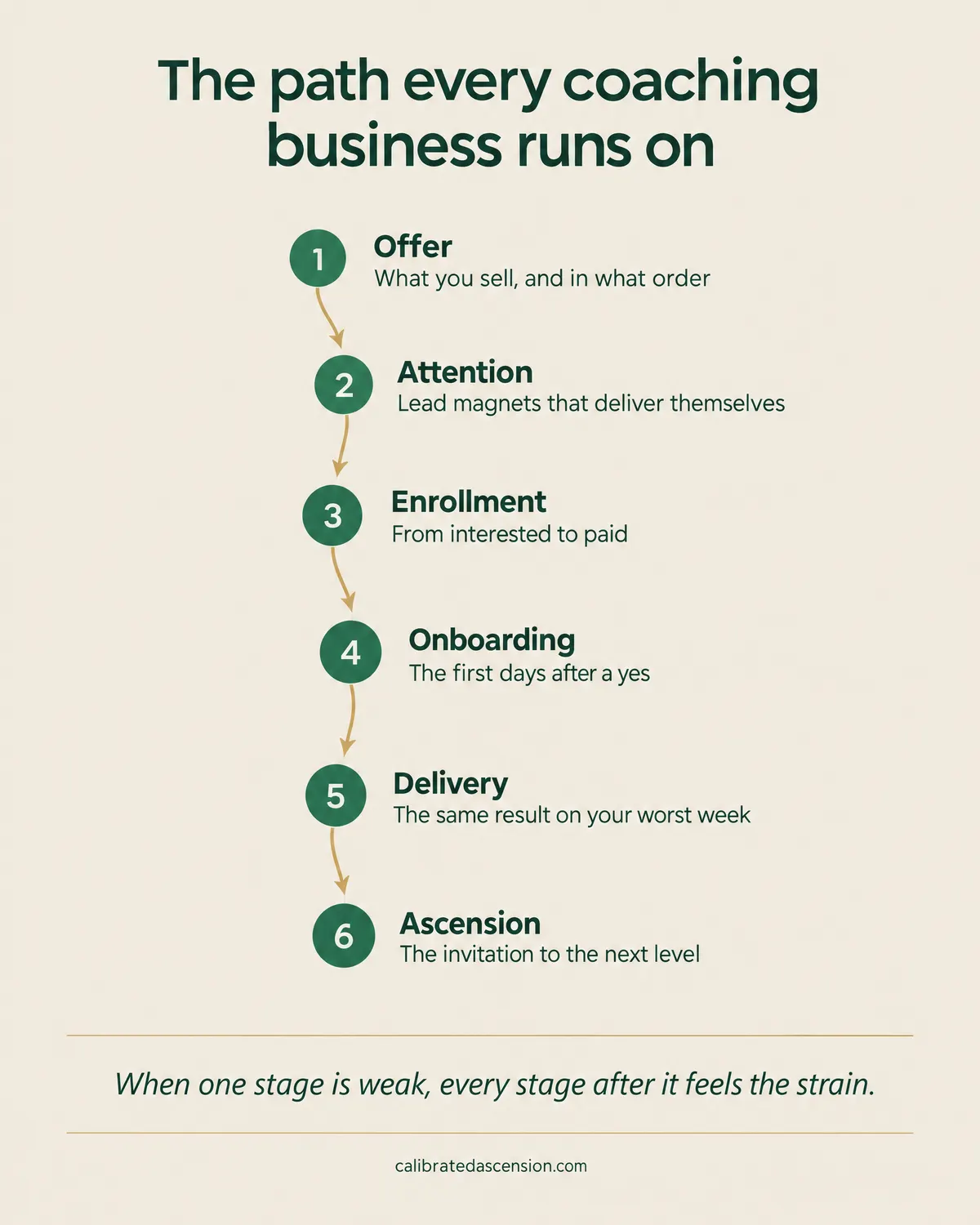
When one stage is weak, the stages after it feel the strain. A vague offer makes enrollment feel like persuasion.
Rough onboarding makes delivery feel heavy. No ascension path means every client relationship ends at the finish line, and you're back to finding new people every month.
03
What this looked like for one client
Sarah was working in corporate, building assets and curriculum for businesses around wellness. She was good at it. When she was ready to do that work for herself, she had real expertise and no business around it yet.
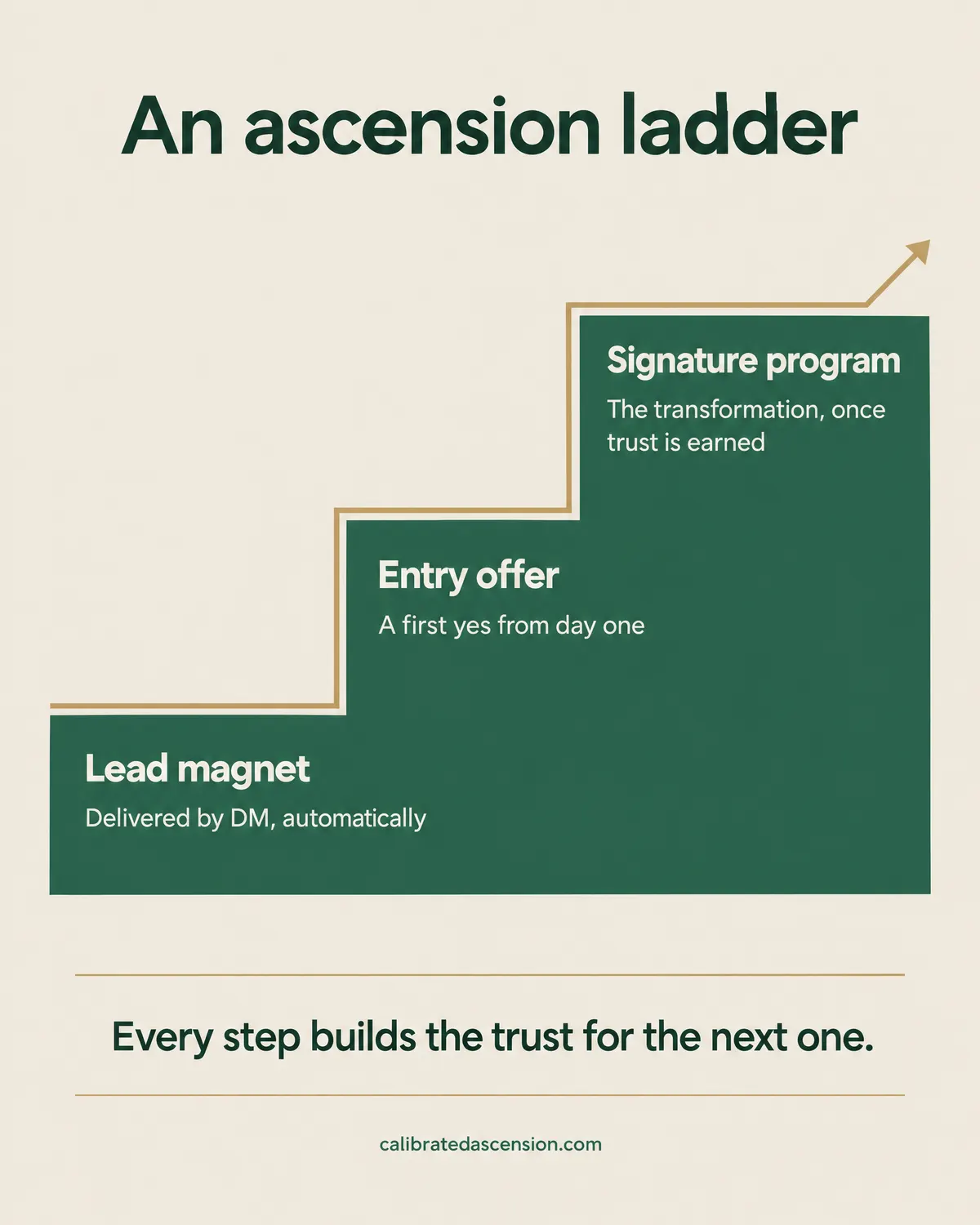
We started with her offers. Using our Ascension pipeline, we organized what she knew into a clear ladder: a low-ticket entry point people could say yes to right away, leading to her high-ticket coaching program. That structure meant she could enroll people from day one, and every low-ticket client was a chance to build the trust that makes a high-ticket yes feel natural.
Then we made sure the offers were converting, with the messaging centered on the transformation her clients wanted. After that we automated it.
We set up her social media DMs to deliver lead magnets on their own, so attention turned into leads without her sending a single message by hand. The follow-up and delivery ran on automations too, so the business kept operating while she slept.

All of that was separate from her website build. Today, Sarah works for herself full time.
04
Why a beautiful website isn't an operating system
Sarah's story is useful because of what it wasn't. It wasn't a website project, and a website alone wouldn't have gotten her there.
Someone can charge you $8,000 or $10,000 for a website, and it can be gorgeous. But if the builders behind it don't understand offer genesis and offer architecture, you end up with a stunning storefront selling a confusing product. People visit, feel something, and leave, because the path from that feeling to a yes isn't there.
So when you evaluate anyone for operations work in a coaching business, ask them to describe your offer ladder back to you. If they jump straight to tools and tasks, they're about to organize something they haven't understood yet.
05
Fractional COO vs OBM vs VA vs integrator
Coaches often hire these roles in the wrong order. Here's how they differ in a service business:
| Role | What they do | Right when |
|---|---|---|
| Virtual assistant (VA) | Completes tasks you assign | You already know exactly what needs doing and just need hands. |
| Online business manager (OBM) | Runs existing systems, projects, and team | The systems exist and need someone to run them day to day. |
| Integrator | Executes the founder's vision inside a framework like EOS | You have a clear visionary and integrator split and a framework in place. |
| Fractional COO | Designs and installs the operating system, then hands it off | The business has outgrown how it runs and needs the machine rebuilt. |
The common mistake is hiring a VA or OBM to fix a problem that lives in the design. They'll work hard and it will still feel heavy, since they're running a system that was never built. The fuller comparison, including cost, is in what a fractional COO actually does.
Who this is for, and the cost
A fractional COO makes sense for coaches and service businesses with a proven offer and real revenue, usually established six- and seven-figure businesses. As a rough line, we look for around $20,000 a month or more before a retainer makes sense. Below that, the money usually does more good going into the offer and the audience first.
Market retainers typically run $3,000 to $10,000 a month depending on scope. Ours are priced by project and scope, never hourly, since the work goes beyond advice.
We consult, we build, and we train your team, with an agency behind us doing the implementation. How we structure the engagement is laid out in how a fractional COO contract is structured, and the partnership itself is on our fractional COO page.
The real difference
The real difference is the starting point. A generalist operator starts with your processes.
An operator who understands coaching starts with your offer, since in your business the offer is the process. Get the ladder right, and the enrollment, onboarding, delivery, and automations have something true to organize around.
Sarah didn't need more hours or a prettier website. She needed a business shaped around the transformation she already knew how to deliver. Once it had that shape, it could run while she slept, and she could stop splitting herself between someone else's company and her own.
Common questions
What does a fractional COO do for a coaching business?
In a coaching business, a fractional COO designs how a stranger becomes a client and how a client gets their transformation, then makes that path run without the coach holding every step. That usually covers the offer ladder, enrollment, onboarding, delivery, automations, lead magnets, and the team roles behind them.
Fractional COO or business coach: which do I need?
A business coach advises you and you do the work. A fractional COO takes responsibility for the operations and helps build them with you, then trains your team to run them. If you already know what to do and the problem is that nobody but you can do it, you need operations.
What's the difference between an OBM and a fractional COO?
An online business manager runs systems that already exist: projects, team, and daily operations. A fractional COO designs the systems in the first place, or rebuilds them when the business outgrows them. Many coaching businesses need a COO to build the machine and an OBM to run it.
At what revenue should a coach hire a fractional COO?
Once the business has a proven offer and consistent revenue. As a rough line, we look for around $20,000 a month or more, which is where the business usually has enough moving parts that structure pays for itself instead of competing with growth.
How much does a fractional COO cost for a coaching business?
Market retainers for fractional COOs typically run $3,000 to $10,000 a month depending on scope. What matters more is what you get for it: advice alone, or advice plus a team that builds the systems and trains your people to run them.
End of post
Continue exploring
Not sure if your offers are ready to build around?
The marketing audit is a paid diagnostic across offers, automation, and traffic. You leave with the analysis and a prioritized checklist, starting with the offer.
Book the marketing audit